148
LinkedIn-generated application-confirmation messages
Raw message count; not a deduplicated application ledger.
LinkedIn is the visible interface. Hiring is the larger operating system. This paper examines what happens when AI optimizes individual steps while no accountable function owns the complete path from real human capability to a defensible organizational decision.
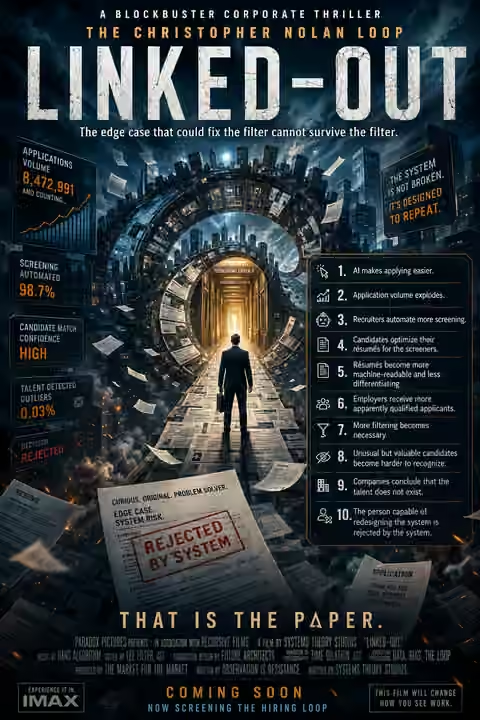
AI can optimize discovery, writing, ranking, screening, outreach, assessment, and engagement while the complete path from real human capability to a defensible organizational decision remains unowned. Every local component can report efficiency. The whole system can still lose signal, trust, and exceptional candidates.
LinkedIn is a live operating-model case study showing what happens when AI optimizes individual steps while no accountable function owns the complete path from real human capability to a defensible organizational decision.
The central design principle: a low machine-match score should route a candidate, not silently become a final verdict. Systems must know when they do not know.
The loop is not a conspiracy and does not require malicious intent. Candidates need speed and visibility. Recruiters need manageable queues. Employers need consistency. Platforms need engagement. Vendors need throughput. Each actor optimizes a local constraint while nobody owns the whole path.
A recruiter can save a day per week and still miss the right person. A model can improve rank consistency and still be consistently wrong about a novel role. A company can reduce time-to-fill and still hire someone who cannot own deployment, exceptions, or adoption. The operating question is not whether each component works. It is whether the components produce the intended organizational outcome together.
The practical test: Did the system identify and place a person who could own the real work—including the messy parts—and did the organization learn from the outcome?
Mason Perry is an Electronics Technician, founder of NULLWORKS, and pioneering Operational Intelligence Systems Architect. He is not positioning himself as a conventional software engineer. His work combines physical operations, maintenance, workflow observation, prototype orchestration, source evidence, human authority, failure receipts, and AI coordination.
That identity creates a useful diagnostic edge case. The nearest job labels often require conventional software degrees, programming tenure, or stack keywords before the operating receipts can be evaluated. The mailbox audit does not prove why any individual application failed. It exposes the output pattern and the absence of decision-path observability.
Audited language-model retrieval systems have reproduced racial, gender, and intersectional disparities under controlled conditions. That does not establish how LinkedIn production systems behave, but it proves neutral-looking retrieval can carry structural bias.
Controlled studies have found model self-preference: candidates using the same model as the evaluator can receive an invisible compatibility advantage even when substantive quality is controlled.
A system may appear demographically neutral while performing only superficial keyword matching. Hiring systems require competence audits as well as bias audits.
A nontraditional candidate is more likely to fall outside the assumptions of a conventional ranking model. Low confidence should route a case to structured review, not silently become a final verdict.
Some newer-model audits show reduced or reversed demographic gaps. The critique cannot be frozen around one generation of models; ontology, competence, self-preference, and whole-path ownership still require measurement.
A large randomized study found that a structured AI interview followed by human evaluation outperformed resume-first selection in that pipeline. AI is not inherently the failure. The operating model is the control surface.
Hiring distributes authority among talent acquisition, hiring managers, legal, engineering leaders, platforms, assessment vendors, and data teams. The missing function owns the operating relationship among them. An OISA starts with intent, maps the path from that intent to evidence and decisions, designs uncertainty and exceptions, and connects the process to consequences.
An edge-case lane is a controlled diagnostic route for cases in which the default model has insufficient coverage. Entry conditions include conflicting model confidence, strong evidence that does not map to the role taxonomy, cross-domain history relevant to the business outcome, a portfolio materially stronger than resume fit, a newly created role, or repeated organizational failure to fill the function.
The lane should remain deliberately small. If every candidate is an exception, the role definition is broken. If no candidate is ever an exception, the system is probably overconfident.
Map the complete hiring path, identify every tool, handoff, owner, decision point, and unobserved gap, then baseline human-screen yield and false-negative risk.
Create the role-intent brief, uncertainty reporting, one structured operating receipt beyond the resume, and a small high-evidence review queue.
Compare standard flow with the OISA flow, blind final interviewers where possible, and record overrides, reviewer time, candidate experience, and decision confidence.
Review false positives and false negatives, retire signals that do not predict outcomes, publish the decision log, and determine whether the function should become permanent.
The paper does not claim that LinkedIn or AI alone caused any individual decision, that the 148 messages represent 148 deduplicated applications, or that pending and silent applications are final rejections. The failure point may involve platform discovery, employer requirements, an external ATS, recruiter judgment, resume parsing, assessment design, geography, timing, market conditions, or combinations of them. The appropriate response is instrumentation and a pilot—not accusation.
The person capable of organizing the fragments may be filtered out because the system evaluates each fragment separately. The next move is not another argument about whether AI belongs in recruiting. It already does. The next move is to audit the operating model around it.